Search This Blog

Saturday, March 12, 2022

Bufflehead

Erika and I strolled past a hen Bufflehead on 7 February 2022 and a male on 24 February at the Billy Frank Jr National Wildlife Refuge. Buffleheads feed in shallow water. They usually dive for their invertebrate prey (fish are also consumed), but occasionally dabble on the water surface. 

Friday, March 11, 2022

Yellow-rumped Warbler

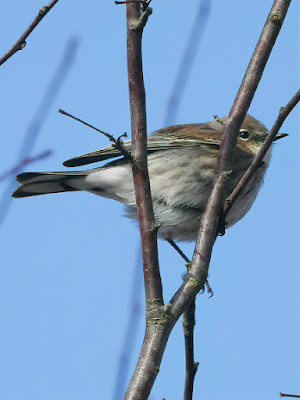
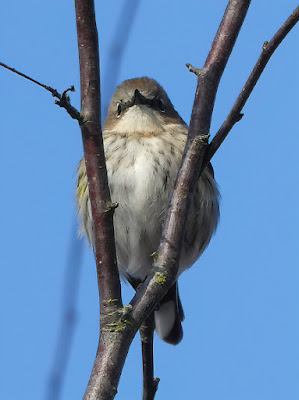
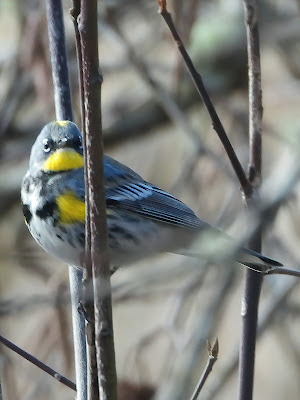
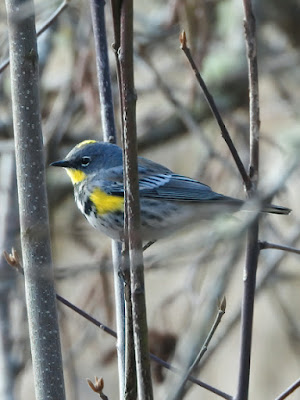
Erika and I saw these Yellow-rumped Warblers on 24 February 2022 at the Billy Frank Jr National Wildlife Refuge. When we moved to Olympia, we did not expect to see both races of this bird—the white-throated Myrtle Warbler and the yellow-throated Audubon’s Warbler. We have always thought of the Myrtle Warbler as an eastern bird, while Audubon’s are western. This assumption is basically correct, but the Myrtle Warbler does breed in Alaska and northern British Columbia. Thus the two races do occur north of us here in Washington and can be expected to migrate through the state. 

Although the two races interbreed in the limited areas where they overlap, ornithologists still argue if they represent one or two species. The Audubon Society writes: “Even though the white-throated Myrtle and yellow-throated Audubon’s types interbreed where they meet, they’re very distinct genetically throughout the rest of their range. The evidence suggests that each is a full species.” The American Ornithological Society’s Checklist Committee has yet to agree.

Thursday, March 10, 2022

Eurasian Wigeon

On 17 February 2022, this Eurasian Wigeon fed among some 20 American Wigeon along the dike trail at the Billy Frank Jr National Wildlife Refuge. These ducks are “fairly common winter residents” in western Washington (Wahl et al. 2005). These authors estimate that about one out of every 400 wigeons here are this species. Not known to breed in North America—birds that winter along the West Coast are assumed to have nested in eastern Asia. For unknown reasons, this duck’s population has increased since 1965.

Wednesday, March 9, 2022

Western Bluebird

On 18 February 2022, Erika and I searched for Western Bluebirds at two prairie preserves south of Olympia. The species is partial to the forest/prairie interface. We struck out at the Scatter Creek Recreation area, but were delighted to find at least ten at Mima Mounds State Park. 
The bluebirds perched on low bushes. The birds flew down to the ground, apparently feeding on insects or fruit. Western Bluebirds are recognized by their brown backs and blue throats. Just to be confusing, some males have blue backs. The females are gray birds that vary in the brightness of their chestnut breasts, and show varying shades of gray or blue on their heads and back.

Monday, March 7, 2022

Red-tailed Hawk

After a light rain on 1 March 2022 at the Billy Frank Jr National Wildlife Refuge, Erika and I photographed a distant Red-tailed Hawk. The bird, one of the dark, western races of the species, appeared to be drying itself. I was pleased by the quality of the recovery of this image by my upgraded versions of my Topaz Labs software.

Sunday, March 6, 2022

American Robin

American Robins, like this one preening on 1 March 2022 at the Nisqually national wildlife refuge, winter in western Washington. During the last couple of weeks, robins have become abundant and must represent the beginnings of spring migration. During early March, my photo processing has evolved, with the upgrading of a couple of Topaz Labs AI apps. I use Topaz Studio, Sharpen AI, and Megapixel. I recommend this software and you can try the apps out for free before you decide to purchase them. (I have not been paid for this shout-out.) 

Saturday, March 5, 2022

Wood Duck

Wood Ducks wintered on Eagle Lake along the Chehallis Bike Trail. By 20 February 2022, these spectacular ducks became common. We easily counted a dozen in every subsequent visit. The bird in the second photo is looking away from the camera. Wood Ducks breed across much of the northern United States and southern Canada but do require woodlands in which to nest or nest boxes. Hunters prize this duck and account for about 10% of the annual duck harvest in the United States (Hepp and Bellrose 2020). Through conservation efforts and hunting regulations, Wood Ducks are now common across most of their range.

Friday, March 4, 2022

Common Teal

Green-winged Teal are found across the Northern Hemisphere. Birds in the Old World, Common Teal, breed from Europe through Asia to the Aleutian Islands. New World birds, Green-winged Teal, are found across Alaska and Canada to many parts of the northern United States. The two populations are now considered to be races of the same species. This status may change, because genetic research shows that, although the races share one haplotype, they otherwise have very different mitochondrial DNA.

Since moving to Washington, Erika and I have searched for Common Teal. These ducks are of casual occurrence along both coasts of North America. We have scanned thousands of Green-wing Teal. On 1 March 2022 we met succeeded. Common Teal lack a white, verticle line behind their breasts. They have strong pale lines across the upper sides of their faces and under their eyes. Common Teal heads are slightly paler than those of Green-winged Teal. Perhaps the white patches on the back ends of Common Teal are a brighter white than the yellowish spots on Green-winged Teal. The sides of the Common Teal are more coarsely barred than on the American race. Our duck shows all these field marks. Less obvious is a white, horizontal stripe formed by the scapular feathers that should be obvious on Common Teals. Note that the scapulars on our duck are white-edged, not dark like on a Green-winged Teal. Not having this stripe apparent may indicate that this bird is a hybrid, but hybrids usually show the Green-wing’s vertical side stripe. Because of the preponderance of all the other field marks, we have no trouble calling this individual as a Common Teal. 

Wednesday, March 2, 2022

American Bittern

All winter an American Bitter hung out along a small, grassy creek at the Billy Frank Jr National Wildlife Refuge. Despite a multitude of eBird reports, we only found the bird twice, most recently on 24 February 2022. In addition to being cryptically colored, bitterns often freeze when approached. We stood on a marsh overlook. Two birders exclaimed, “There’s a bittern!” Erika and I ran over and there in plain sight, calmly strolled a bittern.
At one point the bittern stopped, and leaned over to peer at something in the water. The bird, however, made no strike. Bitterns patiently await passing prey. The birds mostly hunt at dawn or dusk. Almost anything will do—insects, amphibians, crayfish, small fish or small mammals (Lowther et al. 2020). 

Tuesday, March 1, 2022

Surf Scoter

Perhaps not as gaudy as their mates, hen Surf Scoters are nonetheless handsome ducks. Erika and I took this image on 7 February 2022 at the Billy Frank Jr National Wildlife Refuge. Each season, Surf Scoters return to the same breeding and wintering areas. Males, females, and young, however, migrate separately and may use different routes. Surf Scoters winter along both North American coasts. Although there is some overlap in their breeding ranges, western and eastern birds appear to be faithful to either the Pacific or Atlantic coasts (Anderson et al. 2020).